We launched Huellas Indelebles, our micro video podcast.

Listen now

Impact business model

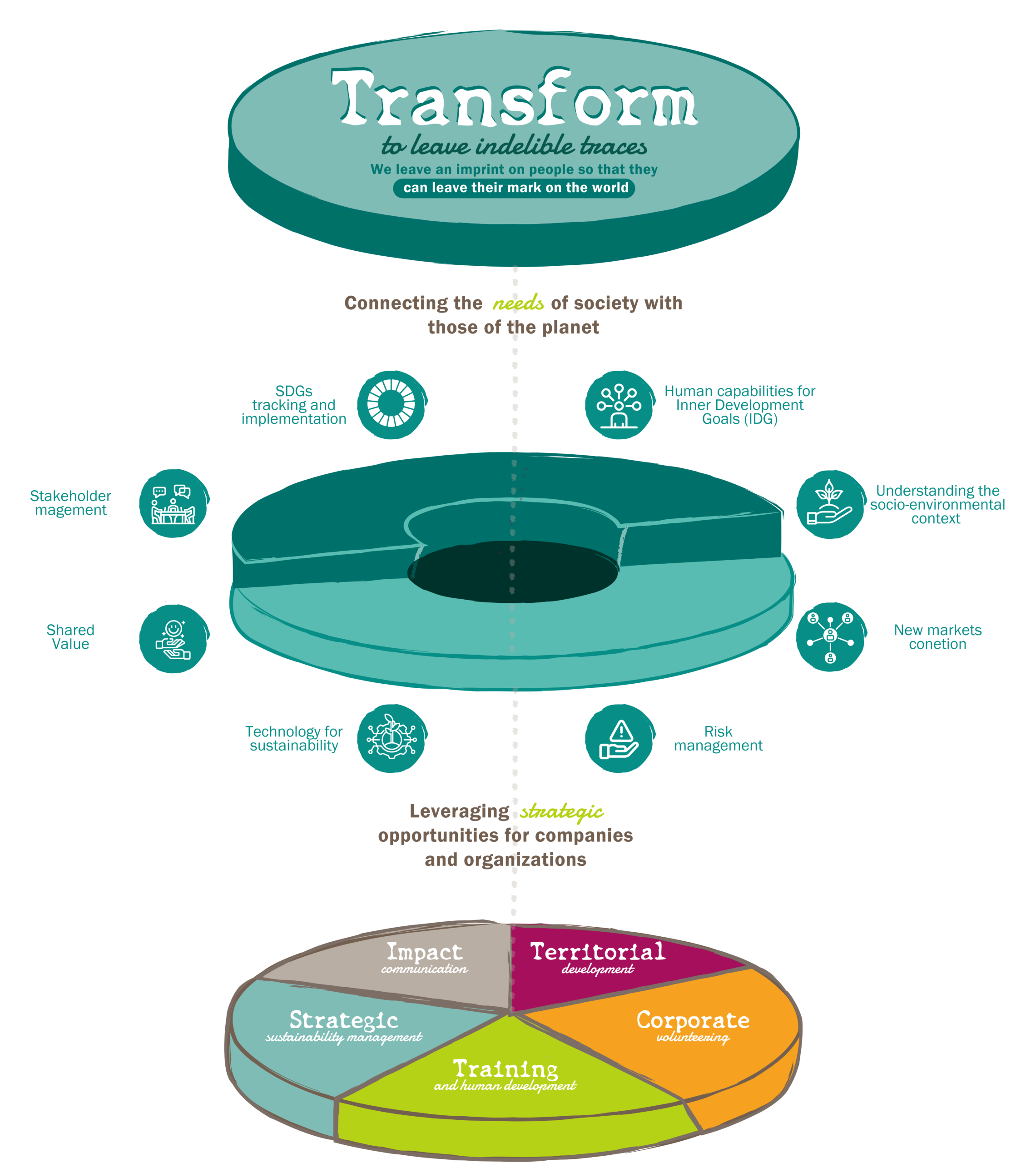
Indeleble Social is a Colombian social enterprise that, for over 10 years, has developed a human-centered impact business model, connecting the needs of society and the planet with the strategic opportunities of companies and organizations.

‘We leave a mark on people, so people can leave their mark on the world’.
This is our purpose, and it’s why our model is based on a humanistic and systemic vision: individual transformation is the foundation for collective and structural transformation.
74% of investors consider stakeholder relationships as a key factor when evaluating a company's sustainability, prioritizing those that integrate effective engagement and communication strategies.

A McKinsey & Company report highlights that companies with greater diversity in their leadership teams are more likely to outperform their competitors in terms of financial performance.

Although the Sustainable Development Goals (SDGs) have been created with a global vision, their real impact depends on local adaptation and enforcement. According to the United Nations Development Programme (UNDP), around 65% of SDG goals require action at the subnational level, which means that local governments, communities and the private sector play a crucial role in achieving and expanding their impact from local to global contexts.

80% of business leaders believe that personal development and conscious leadership are key to solving global challenges. Organizations that promote IDG-related competencies, such as empathy and self-awareness, experience 23% higher productivity and 30% lower employee turnover.

Conservation and environmental preservation: Understanding ecosystems and the interactions between society and the environment is essential for preserving biodiversity, natural resources and ecosystem services. A report by the United Nations Environment Programme (UNEP) highlights the importance of understanding the environment in order to address global environmental challenges.

72% of companies entering emerging markets gain a competitive advantage when they form strategic partnerships with local stakeholders—as long as they adapt their value proposition to local needs.

89% of consumers believe that companies should generate more value than just economic profit, aligning with the principles of Conscious Capitalism and the well-being of their stakeholders.

74% of companies that apply proactive risk management strategies succeed in reducing their financial losses in global crises.

72% of consumers trust companies that use technology to generate a positive social and environmental impact more.

85% of the jobs of 2030 don’t yet exist, which means that organizations must develop opportunities for continuous learning and constant adaptability.

Companies that prioritize sustainable innovation achieve 2.5 times more growth than their traditional competitors.

Companies that work under the shared value framework are 30% more likely to attract impact investing. This is due to the growing trend of financing aimed at sustainable business models.

Impact communication

The power of communicating in an empathetic and effective way to connect with others.

  • Development of communication strategies for your stakeholders.
  • Content adaptation using clear, dynamic and audience-appropriate language.
  • Educommunication strategies.
  • Design, production and execution of experiences.
  • Cultural diagnosis to understand the context of the target audience.
  • Metrics collection and impact evaluation.

Strategic sustainability management

Building a force capable of transformation.

  • Creating sustainability strategies with a participatory approach.
  • Sustainability assessments for the supply chain (ESG-focused).
  • Design of innovation and social investment strategies.
  • Management to close sustainability gaps.
  • Stakeholder identification, prioritization and engagement.
  • Preparation of sustainability reports.
  • Metrics collection and impact evaluation.
  • Leadership of strategic sustainability areas.

Training and human development

Unlocking the full potential of the Self.

  • Design and implementation of formative experiences focused on being and doing.
  • Training topics based on the Inner Development Goals (IDGs).
  • Metrics collection and impact evaluation.
  • Modalities: in-person, virtual and hybrid.

Corporate volunteering

Building a force capable of transformation.

  • Support in the design of volunteering strategies.
  • Activation, restructuring and strengthening of existing volunteer programs.
  • Indelible volunteering experiences: Environmental and social volunteering.
  • Management of volunteering programs.
  • Metrics collection and impact evaluation.

Territorial development

Building capabilities that generate real impact.

  • Design and execution of social and community management strategies.
  • Mapping, profiling, and management of stakeholders in your impact community.
  • Design of social management tools.
  • Analysis of territorial challenges and opportunities.
  • Mapping and coordination with strategic partners.
  • Metrics collection and impact evaluation.